
Written by: Sohail Bawa, Khatam-e-Nabuwwat Academy London
Date: April 30, 2026
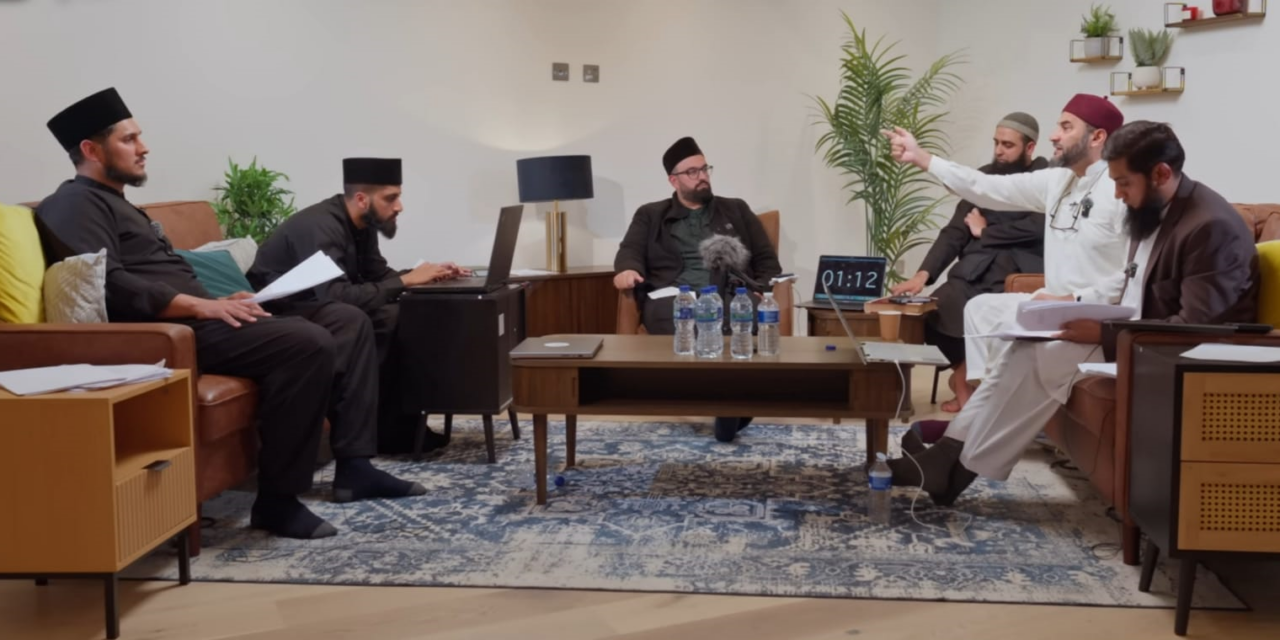
The historic days of April 29 and 30, 2026, have given significant prominence to the debate involving the followers of Mirza Ghulam Ahmad Qadiani, the Mirzai or Qadiani community in London across social media. In this context, people are expressing their opinions, while many also appear confused or concerned—largely because the majority are not familiar with the art and discipline of such discussions. Therefore, a few important points are presented here. ☝️
The Qadiani community considers itself a separate ummah, and according to them, their religion and Islam are distinct from one another. They openly acknowledge that they differ from Muslims in every matter—even in the very name of their faith. However, when it comes to practical discussions or debates, they often divert from the core issue and raise questions that are unrelated to the fundamental disagreement.
This is a structured approach through which they complicate the discussion. For example, when the topic is something as fundamental as Khatam-e-Nabuwwat (Finality of Prophethood), they may suddenly introduce the hadith of “73 sects” or other irrelevant issues. The purpose is not to clarify the truth, but to create doubt and confusion in the minds of the general public.
There is a clear need for such discussions to be conducted strictly according to principles. The first and foremost condition is that the conversation must remain confined to the agreed topic. Irrelevant questions should be clearly rejected. Any leniency in this regard only leads to confusion.
Another important issue is the misuse of the writings of the Sufi scholars. Qadiani representatives often quote Sufi texts out of context, whereas in reality, the beliefs of the Sufiya are aligned with the mainstream Ahl al-Sunnah. They are in agreement with the ummah on core beliefs such as the Finality of Prophethood and the life of Prophet ‘Isa (peace be upon him). Using Sufi literature to establish doctrinal arguments in this manner is academically dishonest, as every discipline has its own scope and methodology.
Similarly, presenting weak or fabricated hadith as evidence is a common tactic. To counter this, it is essential to provide complete references from authentic sources, along with the original text. Incomplete or unreliable citations should be rejected immediately.
It must also be understood that engaging in such discussions is not for everyone. Just as driving requires proper training and a license, debate also demands knowledge, experience, and an understanding of principles. Entering such discussions without preparation can be harmful—not only for oneself but also for the general public.
The most critical stage is setting the terms before the discussion begins. In reality, defining the conditions is itself the core of the debate. If there is weakness at this stage, the entire discussion becomes compromised. The success of our senior scholars was rooted in the fact that they firmly established principles and conditions before engaging in dialogue.
In summary, seriousness, adherence to principles, and intellectual integrity are essential when engaging with Qadianis. Avoiding irrelevant arguments, relying on authentic evidence, and staying focused on the agreed topic are the keys to a successful and effective discussion. Ignoring these principles will only lead to confusion and harm rather than benefit. ☝️






Recent Comments