
By: Sohail Bawa, Khatam-e-Nabuwwat Academy London
Prophet Muhammad (peace be upon him) once said:
“May Allah curse the Jews and the Christians; they took the graves of their prophets as places of worship.” (Sahih Muslim and others)
In this context, The followers of Mirza Ghulam Ahmad Qadiani argue that since the given hadith mentions both Jews and Christians separately, and since Christians only have one prophet — Jesus (peace be upon him) — it implies that they must have turned his grave into a place of worship. They add that having an actual grave indicates the fact that Jesus has passed away. On the other hand, for us Muslims, this is an utter misinterpretation of this hadith — a deliberate attempt to pull the wool over others’ eyes. We have a different belief in this regard, based on the “aqaaid” of the Ahl-e-Sunnah Wal Jama’ah.So, let us try to set the record straight. From the outset, this Ahmadi(Qadiani) interpretation seems persuasive, but upon closer examination, the argument falls apart.Below are a few responses:
Christians believe in many prophets:
The assumption that Christians have only one prophet is fundamentally flawed. In fact, they believe in many prophets. Both Jews and Christians believe in a long chain of prophets — from Adam (peace be upon him) to Moses (peace be upon him). Their disagreement is only regarding the prophecy of Jesus. Jews reject him altogether, while Christians accept him as a true messenger of Allah. This means that Christians do not believe in only one prophet, but several. Therefore, if Christians have taken the graves of any of those earlier prophets as places of worship, the hadith is validated. Thus, the statement does not require that it must specifically be the grave of Jesus.
A similar example can be found in the writings of Mirza Mahmood (the second Qadiani Khalifa), who stated:
“Whoever says that a prophet must necessarily bring a book (with him) is denying history, and would have to reject many prophets of the Hindus, Jews, and Christians, because there have been prophets among them who did not bring a book.” (Anwar Al-Khilafat, Anwar Al-Ulum, Vol. 3, p. 123)
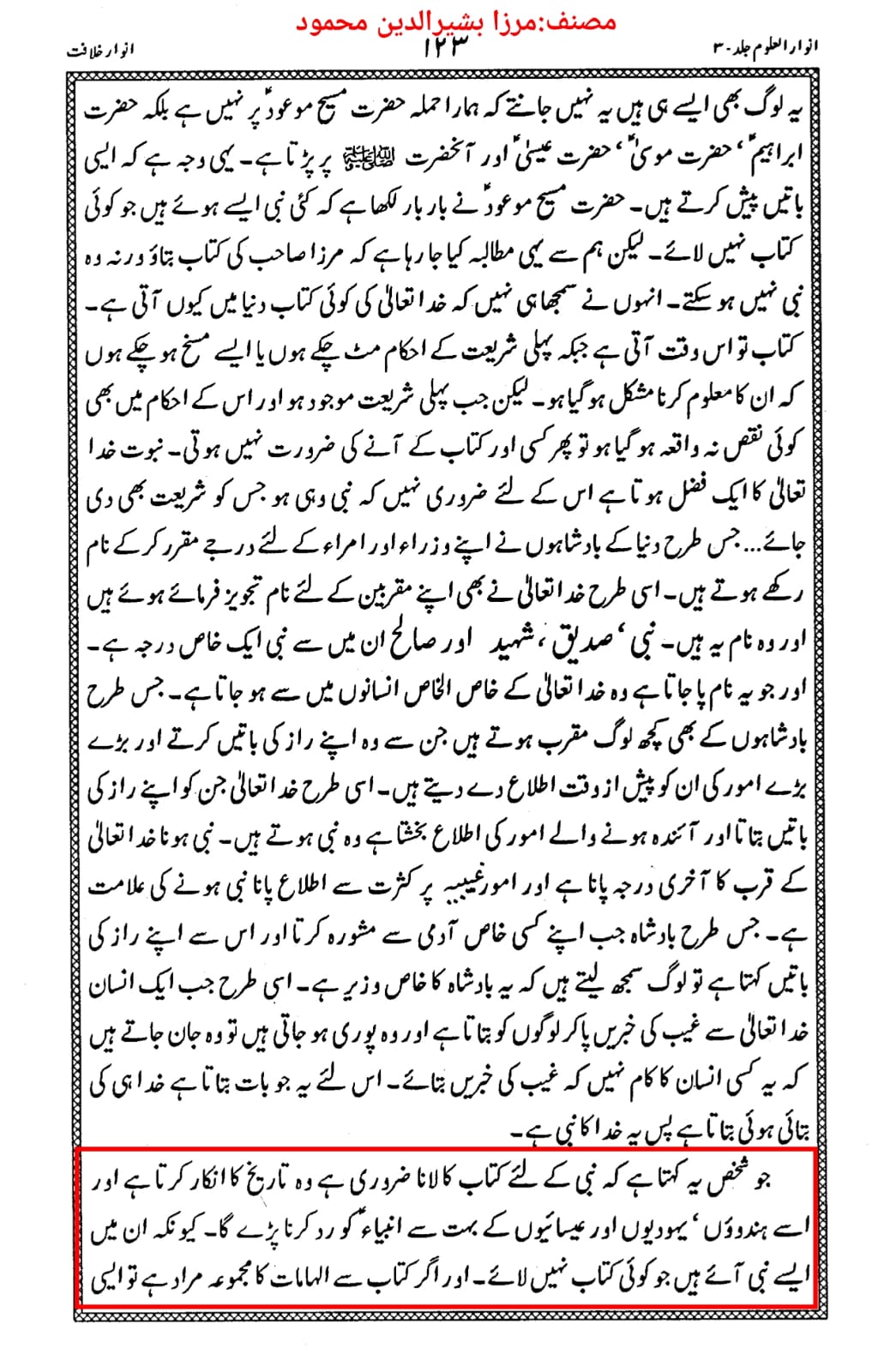
Here, the phrase “many prophets of the Jews and Christians” does not mean that Christians independently have many separate prophets. It refers to the shared body of prophets recognized by both traditions. Similarly, the hadith refers collectively to all prophets whom Jews and Christians acknowledge. Their argument backfires: Even for the sake of discussion, if we accept the Qadiani argument for a while, it backfires and actually proves the opposite. There is no historical or biblical account of such a burial site anywhere on earth that Christians believe to be of Jesus, nor have they turned such a grave into a place of worship. In fact, mainstream Christian belief holds that Jesus was crucified, placed in a tomb briefly, and then rose and ascended to the heavens. They do not believe his body remains buried in the earth. Given this historical fact, how could they have turned it into a place of worship? This directly contradicts the Ahmadi claim. Jesus buried in Kashmir — a false claim Mirza Ghulam Ahmad, founder of the Qadiani religion, has claimed that Jesus is buried in Srinagar, Kashmir. This is another attempt to hoodwink common Muslims. Let us ask the followers of Mirza Ghulam Ahmad Qadiani to prove that Christians ever turned this so-called grave at the Roza Bal shrine in Srinagar into a place of worship. Christians completely reject the claim that Jesus was ever buried there. Therefore, if the hadith necessarily required Christians to worship the grave of Jesus, Mirza’s own claim about Srinagar would also become false according to that logic. Ahmadis would then have to look for another “grave” of Jesus, which Christians actually turned into a place of worship.
Another argument fails:
Some Ahmadis might respond to this by saying that Christians worship at the place where, according to Catholic belief, Jesus was placed for three days after the crucifixion. But this argument also falls flat. Firstly, we Muslims reject the Christian claim that Jesus actually died on the cross and was buried for three days. Even Mirza himself denied it.Therefore, according to the Ahmadis’ own belief, Jesus was alive after the crucifixion incident. A grave is obviously dug only for a corpse, not for someone alive. So even if Christians believe he remained there temporarily for three days, that location still cannot truly be called a grave. The real grave, according to the Ahmadi belief, would only be the place where Jesus eventually died and was permanently buried, which they claim is in Kashmir. Thus, it is impossible to argue that the hadith mentioned earlier refers to the temporary tomb claimed by Christians, because according to Mirza himself, Jesus was alive at that time. The hadith speaks about real graves containing dead bodies — not empty or temporary sites for corpses.
Conclusion:So it’s very simple. The Ahmadi interpretation of the above-mentioned hadith as a proof of Jesus being dead and buried is deeply flawed. It wrongly assumes Christians have only one prophet. It ignores the shared prophetic tradition between Jews and Christians. It contradicts established Christian beliefs. It fails to provide any historical evidence of Christians worshipping the grave of Jesus. It collapses entirely when examined in light of the “Srinagar claim.” The hadith in discussion is fully vindicated and authenticated. There is no requirement — nor any evidence — that this must specifically refer to Jesus. May Allah guide Ahmadi people to the right path. Ameen



Recent Comments